

Every single lead stored in your marketing database has a hard acquisition cost. Whether you acquired that lead through Facebook Lead Ads (CPL), a sophisticated LinkedIn outreach campaign, or a multi-year content marketing strategy, you paid for it. However, statistics consistently show that email lists decay naturally at a rate of roughly 22.5% per year. People change jobs, companies consolidate or go under, and domains are allowed to expire.
If you are paying your Email Service Provider (ESP)—giants like Mailchimp, HubSpot, or Klaviyo—based on the total number of contacts stored in your account, you are likely paying a significant "Zombie Tax." You are paying real money to store and attempt to message people who physically cannot receive your mail.
Eliminating the "Zombie Tax" and ESP Optimization
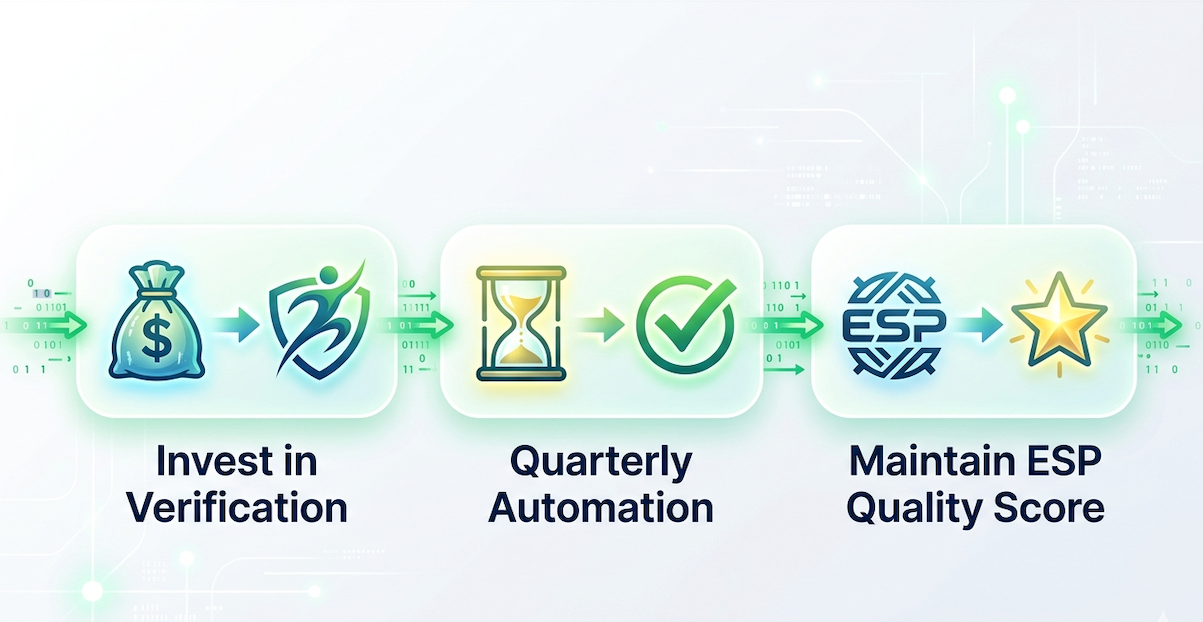
By implementing a standard list cleaning protocol (we recommend a quarterly deep clean) with UseBouncer, you can systematically prune your database of this dead weight. For enterprise-level senders with lists in the hundreds of thousands or millions, this "pruning" can result in direct, immediate savings on ESP subscription costs—often amounting to thousands of dollars per quarter.
This isn't just "list cleaning"; it is proactive cost optimization. UseBouncer provides you with a definitive report categorization (e.g., Deliverable, Risky, Undeliverable, or Unknown). This allows you to segments your audience intelligently. You can instantly archive the 'Undeliverable' segment, keeping your active sending database streamlined, efficient, and cost-effective.
Improving Your Quality Score: The Algorithm's View
Email Service Providers and marketing platforms (like Salesforce Marketing Cloud or Marketo) do not just send your emails; they assign an internal "Engagement Score" or "Quality Score" to your account based on your performance history. Platforms make money by delivering high-quality, engaging content to users.
High bounce rates (anything over 1%) and low engagement signals (opens/clicks) are strong negative factors. If you consistently show poor engagement metrics, the platform's algorithm will interpret your content as low-quality, unsolicited, or spam. To protect their own server infrastructure's reputation, the ESP might start "throttling" your sending speed, limiting how many emails you can send per hour, or even suspending your account entirely.
UseBouncer solves this from the top of the funnel. By ensuring that every email you send has the highest possible probability of being received, opened, and clicked, you systematically keep your "Quality Score" high. This maintains your account’s good standing and ensures you have full access to the platform’s highest sending tiers and best deliverability speeds.
Data Hygiene as a Competitive Advantage
A high-quality, verified email list isn't just about saving money; it is about building a competitive marketing asset. A clean list allows for more precise personalization and segmentation. When you know every address is valid, your data analysts can trust the open and click-through metrics, enabling them to make better strategic decisions. You are no longer guessing based on a bloated, inaccurate data set. In 2026, the brands that can make faster, data-backed decisions will outperform those struggling with "dirty" data. Data hygiene, facilitated by UseBouncer, moves from a clerical task to a core strategic advantage.


