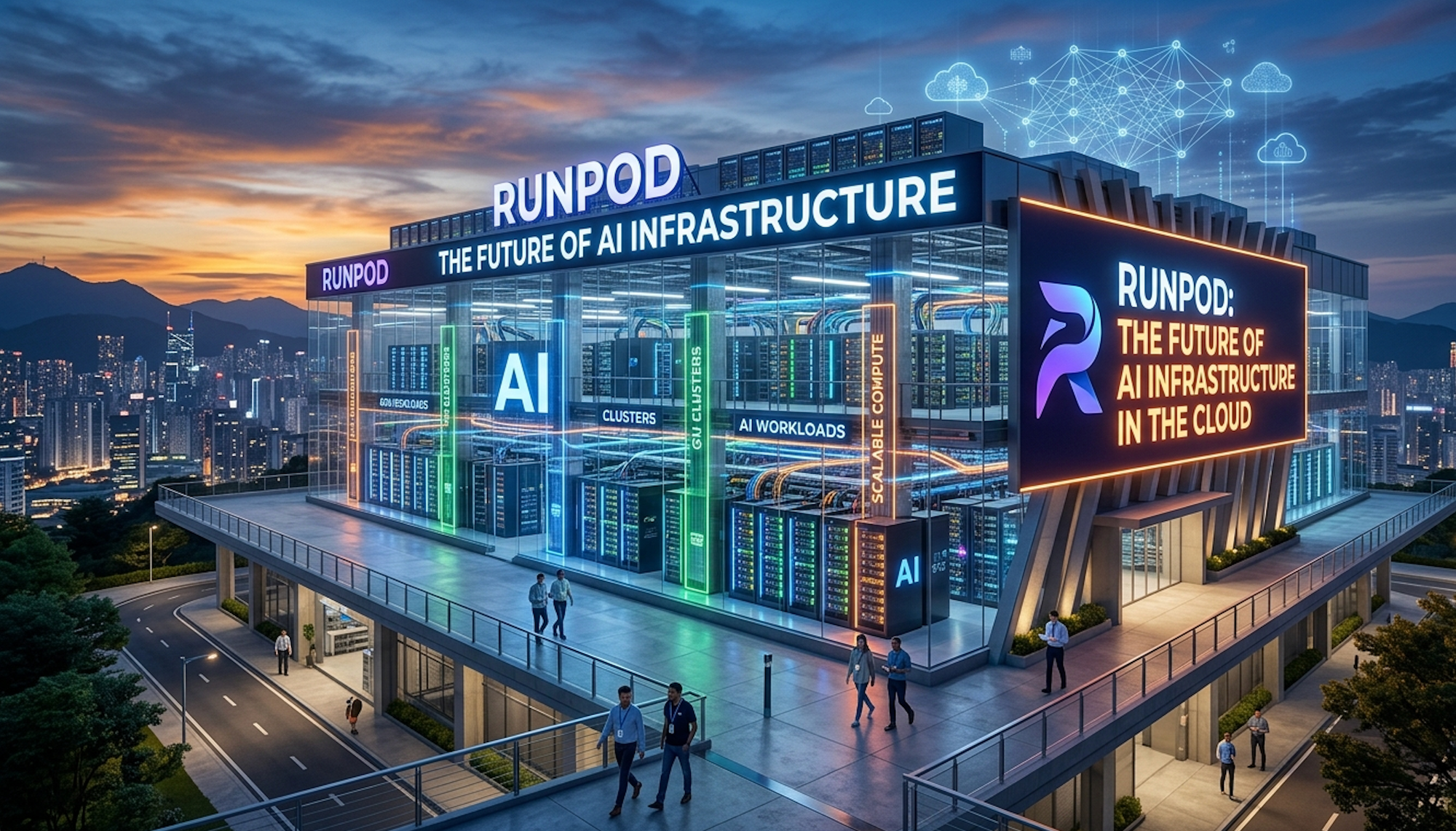

In today’s rapidly evolving AI landscape, one of the biggest challenges developers face is access to powerful computing resources ⚡. Training machine learning models, running inference, or experimenting with generative AI tools requires high-performance GPUs — something not everyone can afford or maintain locally 💸.
This is where Runpod enters the picture — a platform designed to simplify AI development by providing scalable, on-demand GPU infrastructure. Whether you are a startup founder 🚀, a student 🎓, or an enterprise engineer 🏢, Runpod offers a powerful ecosystem to build, train, and deploy AI applications efficiently.
🌟 What is Runpod?
Runpod is a cloud computing platform specifically built for AI and machine learning workloads. It provides access to high-performance GPUs and CPUs, allowing developers to run compute-intensive tasks without managing physical hardware 🖥️.
At its core, Runpod aims to remove infrastructure complexity and let developers focus purely on building AI products. Instead of worrying about server setup, GPU availability, or scaling issues, users can deploy workloads in minutes ⏱️.
👉 In simple terms:
Runpod = AI development + cloud GPUs + zero infrastructure headaches 😌
💡 Why Runpod is Gaining Popularity
The demand for AI tools has exploded in recent years 📈. From ChatGPT-like models to image generators and video AI, developers need powerful systems — and Runpod delivers exactly that.
According to platform insights, Runpod supports hundreds of thousands of developers and processes millions of serverless requests monthly 🚀.
Here are a few reasons why it stands out:
⚡ 1. Instant GPU Access
Runpod allows you to launch GPU-powered environments in seconds — no setup required.
👉 Imagine needing an RTX 4090 or advanced GPU…
👉 Instead of buying it, you just click and use it instantly 😎
🌍 2. Global Deployment
Run workloads across multiple regions worldwide 🌐, ensuring low latency and better performance for global applications.
🔄 3. Serverless AI Scaling
Runpod’s serverless feature allows applications to scale automatically from 0 to thousands of GPU workers depending on demand 📊.
💥 This means:
- No idle cost
- No manual scaling
- Pay only for what you use
💰 4. Cost Efficiency
Runpod is known for reducing infrastructure costs significantly — some users report saving up to 90% compared to traditional setups 💸.
🧠 Core Features of Runpod
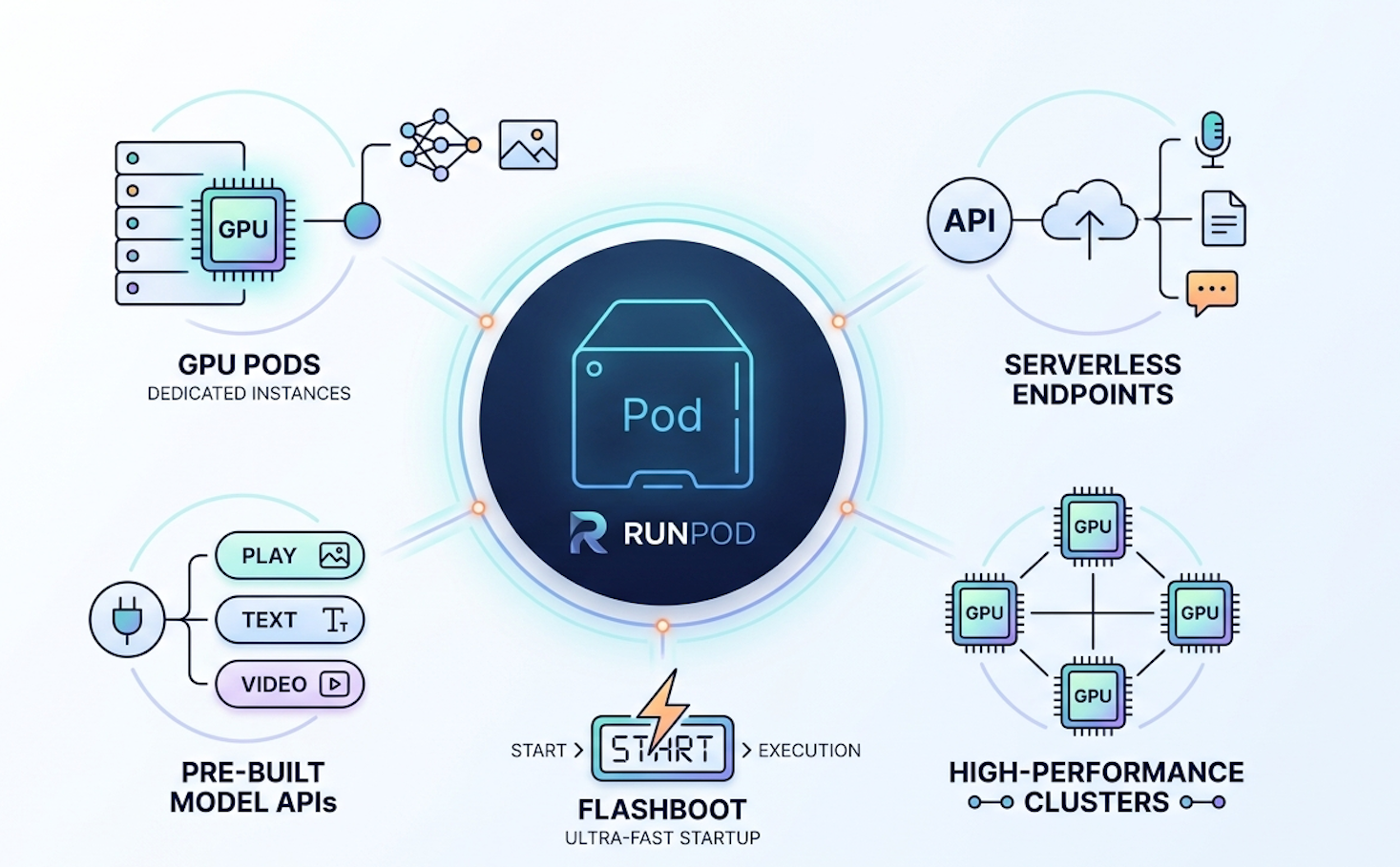
Let’s break down what makes Runpod a powerful platform 🔍:
🧩 1. GPU Pods (Dedicated Instances)
Runpod offers Pods, which are dedicated GPU or CPU instances for running workloads.
✔ Ideal for:
- Training ML models
- Running Stable Diffusion 🎨
- Hosting AI services
⚙️ 2. Serverless Endpoints
Runpod allows developers to deploy AI models as APIs without managing servers.
✔ Use cases:
- Image generation APIs
- Text generation (LLMs)
- Audio/video processing 🎥
🔌 3. Pre-built Model APIs
You can directly use pre-deployed models via API — no setup required.
Example:
- Generate images 🖼️
- Process text 📄
- Create videos 🎬
🧠 4. High-Performance Clusters
For advanced users, Runpod supports distributed GPU clusters for large-scale AI training.
✔ Perfect for:
- Deep learning research
- Enterprise AI systems
- Large-scale simulations
⚡ 5. FlashBoot Technology
Runpod offers ultra-fast startup times (<200ms) for workloads ⚡, ensuring near-instant execution.
🛠️ Use Cases of Runpod
Runpod is not limited to one domain — it powers multiple AI-driven industries 🚀:
🎨 1. Generative AI
- Stable Diffusion
- Image & video generation
- AI art tools
💬 2. Large Language Models (LLMs)
- Chatbots 🤖
- AI assistants
- Content generation
🎥 3. Video & Media Processing
- AI video upscaling
- Animation generation
- Visual effects
📊 4. Data Science & Analytics
- Data processing pipelines
- Predictive modeling
- Real-time analytics
🏗️ 5. Startups & SaaS Products
Runpod helps startups scale quickly without infrastructure bottlenecks 🚧.
🧑💻 Developer Experience
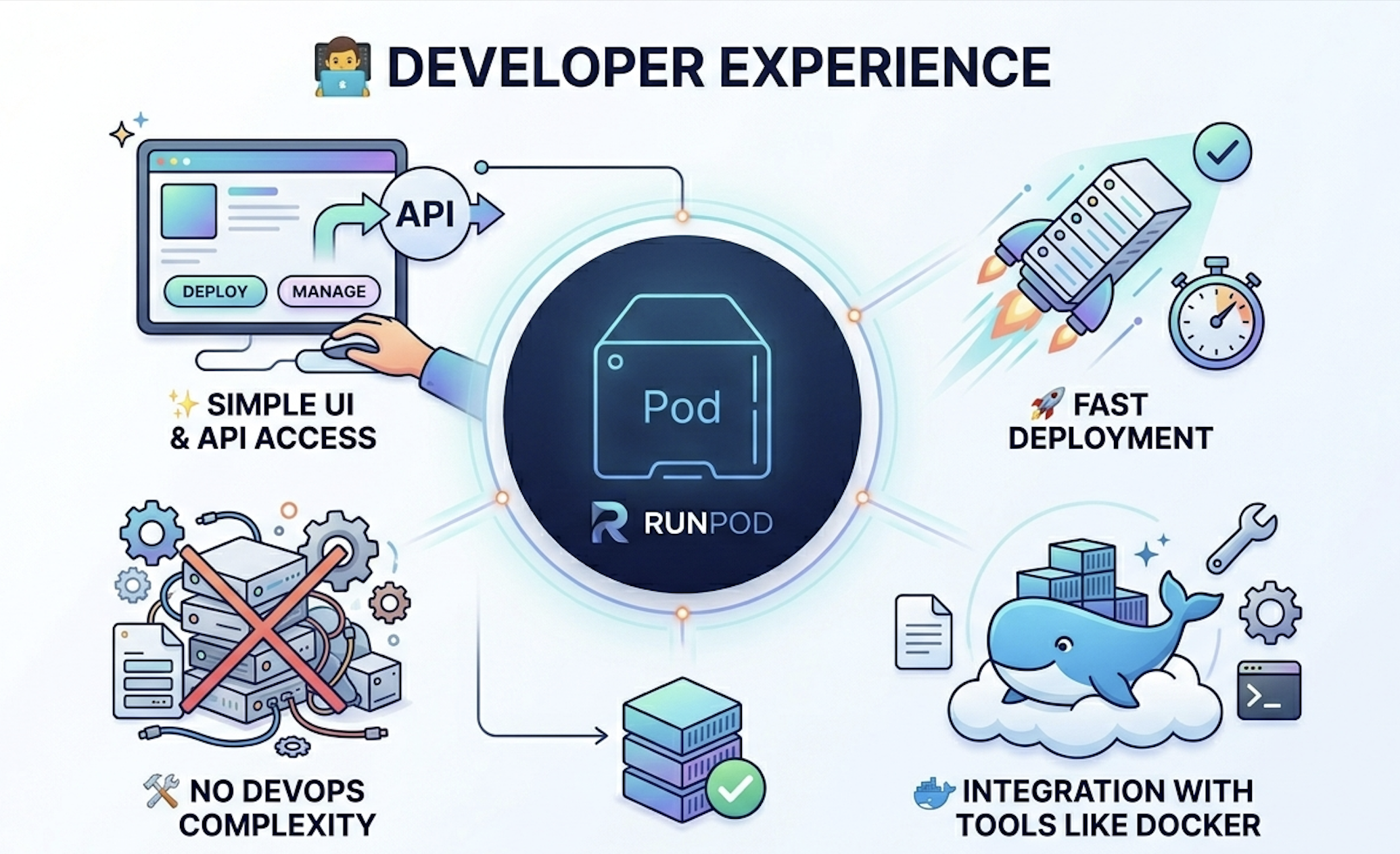
Runpod is built with developers in mind 💙.
✨ Key Developer Benefits:
- Simple UI & API access
- Fast deployment
- No DevOps complexity
- Integration with tools like Docker 🐳
The platform also provides documentation and guides to help users deploy AI applications easily.
📊 Runpod vs Traditional Cloud Providers
| Feature | Runpod 🚀 | Traditional Clouds ☁️ |
|---|---|---|
| Setup Time | Seconds ⚡ | Hours ⏳ |
| GPU Access | Instant | Limited / Expensive |
| Scaling | Automatic 🔄 | Manual |
| Pricing | Pay-as-you-go 💰 | Complex billing |
| AI Focus | Specialized 🤖 | General-purpose |
🌐 Runpod’s Evolution
Runpod has evolved from a simple GPU provider into a full AI platform.
Its redesigned platform now supports:
- Real-time inference
- Custom LLM deployments
- Open-source AI workflows
This shows that Runpod is not just keeping up with AI trends — it’s actively shaping the future 🔮.
🔐 Security & Reliability
Runpod provides enterprise-grade features:
🔒 SOC 2 Type II compliance
📈 99.9% uptime
🌍 Global infrastructure
This makes it suitable for both startups and large organizations 🏢.
⚠️ Challenges & Considerations
While Runpod is powerful, there are a few things to keep in mind:
❗ Requires basic knowledge of AI/ML workflows
❗ Costs can increase with heavy usage
❗ Cloud dependency (internet required 🌐)
Still, compared to buying expensive GPUs, it’s often a much better option 💡.
🔮 The Future of Runpod
AI is only getting bigger 📈 — and platforms like Runpod are at the center of this revolution.
With trends like:
- AI agents 🤖
- Video generation 🎥
- Real-time AI apps ⚡
Runpod is positioned to become a key infrastructure layer for next-gen applications.
🏁 Conclusion
Runpod is more than just a cloud platform — it’s a complete AI infrastructure solution 🚀.
It empowers developers to:
✔ Build faster
✔ Scale effortlessly
✔ Save costs
✔ Focus on innovation
Whether you're experimenting with AI for the first time or building production-grade systems, Runpod provides the tools you need — without the traditional complexity.
✨ Final Thoughts
In a world where AI is becoming the backbone of innovation 🌍, platforms like Runpod are democratizing access to powerful computing.
💡 You no longer need:
- Expensive hardware
- Complex infrastructure
- Large DevOps teams
Instead, all you need is an idea 💭 — and Runpod will handle the rest ⚡